Clear Aligners Clermont-Ferrand | Invisible Treatment
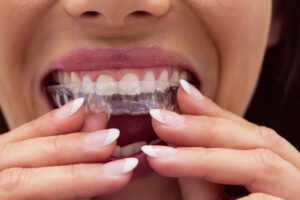
The OrthoClermont practice of Dr Alexandra Normand, dental surgeon practising orthodontics exclusively in Clermont-Ferrand, offers treatment with clear aligners. These custom-made transparent medical-grade plastic trays represent a modern alternative to traditional braces. The principle is straightforward: a series of successive aligners progressively moves teeth into their final position, without any metal wire or visible bracket.
How clear aligners work
Treatment begins with a three-dimensional intra-oral digital scan. From this data, planning software models the entire treatment: every tooth movement is anticipated, step by step, from start to finish. The patient can visualise the final result on screen before even beginning — one of the major advantages of this technique.
A series of aligners (between 15 and 50, depending on the complexity of the case) is then manufactured. Each aligner corresponds to a stage of treatment and must be worn for approximately one to two weeks before moving to the next. The aligner applies gentle, controlled pressure on the teeth to guide them towards their new position. Movements are in the range of 0.2 to 0.3 millimetres per aligner, which explains the superior comfort compared to fixed appliances.
Wearing aligners day to day
The aligners must be worn at least 22 hours per day for treatment to progress normally. They are only removed for meals and tooth brushing. This is both the advantage and the constraint of this technique: the patient enjoys complete freedom to eat — with no dietary restrictions — and hygiene is simplified since brushing is carried out without any obstacle. In return, the success of treatment depends directly on the patient's discipline in wearing their aligners.
Each aligner is virtually invisible once in the mouth. Even at close range, you have to look carefully to detect it. The aligners do not significantly alter speech — a very slight modification may occur during the first few hours, while adjusting to a new aligner.
Attachments
To optimise certain movements, small tooth-coloured composite attachments are bonded to the surface of certain teeth. They act as grip points for the aligner and enable more complex movements (rotations, extrusions). These attachments are discreet and are removed without difficulty at the end of treatment, leaving no trace on the enamel.
Treatment process at OrthoClermont
The first consultation includes a thorough clinical examination, radiographs and a digital scan. Dr Alexandra Normand assesses whether clear aligners are suited to your case or whether another technique would be more effective. Not all cases lend themselves to aligners: severe malocclusions, cases requiring multiple extractions or certain complex vertical movements may require a fixed appliance.
If aligners are chosen, the digital treatment plan is finalised in consultation with the patient. Aligner manufacturing takes approximately two to three weeks. Attachment placement and delivery of the first aligners take place during a dedicated appointment, during which all wearing and care instructions are explained in detail.
Follow-up appointments are spaced six to ten weeks apart, which is less frequent than with a fixed appliance — a welcome advantage for patients with busy schedules or who travel regularly.
Advantages of clear aligners
- Aesthetics: aligners are virtually invisible in the mouth
- Comfort: no brackets or wires to irritate cheeks or lips
- Removable: complete freedom to eat, drink and brush teeth
- Simplified hygiene: no risk of decalcification around brackets
- Predictability: the final result is simulated in 3D before treatment begins
- Fewer practice appointments than with conventional fixed treatment
- No dietary restrictions
Limitations and contraindications
Clear aligners are not suited to every clinical case. Severe malocclusions, significant skeletal discrepancies, cases requiring complex tooth movements (intrusion, significant root torque) or patients whose cooperation is uncertain are better managed with a fixed appliance. Dr Alexandra Normand evaluates each situation individually and only recommends aligners when they can guarantee results as good as a conventional appliance.
In children and young teenagers whose permanent teeth have not yet fully erupted, aligners may be considered in certain cases, but a fixed appliance often remains more suitable during this growth period.
Caring for your aligners
The aligners should be rinsed with lukewarm water after each removal and cleaned morning and evening with a soft toothbrush and a little mild soap. You should avoid hot water (which could warp the plastic) and abrasive toothpastes (which could scratch them and make them cloudy). The aligners must never be worn while eating or drinking coloured or hot beverages — only water is permitted while wearing them.
Cost and fees
The cost of clear aligner treatment depends on the number of aligners required and therefore the complexity of the case. A personalised quote is drawn up at the initial consultation. As with other techniques, treatments started before the age of 16 benefit from French social security coverage. For adults, many supplementary insurance plans include an orthodontic allowance. The OrthoClermont practice in Clermont-Ferrand offers flexible payment plans to spread the cost of treatment.
Frequently asked questions about clear aligners
Can I smoke with aligners?
It is strongly advised against smoking with aligners in the mouth: heat and nicotine stain and warp the plastic. Smokers must remove their aligners for each cigarette, which can reduce daily wear time below the necessary threshold.
What should I do if I lose an aligner?
Contact the practice. In the meantime, wear the previous aligner to keep teeth in position. Do not move on to the next aligner without your orthodontist's advice.
Do clear aligners hurt?
Each new aligner causes a sensation of pressure for one to two days, which is a sign that the teeth are moving. This discomfort is notably less than that felt during the activation of a fixed appliance. Most patients describe a feeling of tightness rather than actual pain.
Treatment duration
Duration varies according to the complexity of the case: from 6 months for mild crowding to 18 months, sometimes 24 months, for more significant corrections. At the end of active treatment, a retention phase is put in place — most commonly a bonded wire behind the teeth combined with a night-time retainer — to permanently stabilise the results. Retention follow-up is provided by the OrthoClermont practice in Clermont-Ferrand.
Need an appointment?
Call us - 04 73 44 79 98